
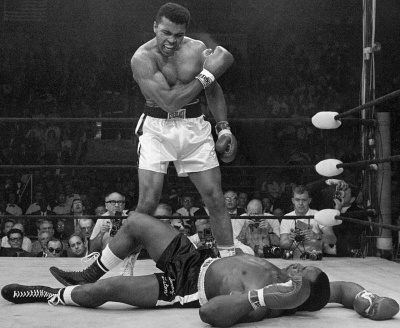
Muhammad Ali was born on January 17, 1942 in Louisville, Kentucky. At the age of twelve, his bicycle was stolen and in a desire to get revenge on the thief, he began taking boxing lessons from Louisville police officer Joe Martin. As an amateur boxer, Ali won two Golden Gloves titles, two Amateur Athletic Union national titles, and had an outstanding record of 100 wins and eight losses. In 1960, Ali participated in the Olympics in Rome and won the light-heavyweight gold medal.
Ali began his professional boxing career on October 29, 1960. He won his first nineteen fights, which earned him a shot at the heavyweight championship belt that was held by Sonny Liston. The fight took place on February 25, 1964. Ali, who was a 7-1 underdog, upset the odds with a 7th round technical knockout win over Liston. He defeated Liston in a rematch on May 25, 1965 by knockout in round one.
The day after Ali’s first victory over Liston, Ali held a press conference and announced his conversion to the Nation of Islam. He changed his name from Cassius Clay to Muhammad Ali, which was bestowed on him by Nation of Islam leader Eljiah Muhammad.
Ali had eight successful heavyweight challenges before he was stripped of his boxing license in 1967 and his heavyweight championship belt by the New York State Athletic Commission for refusing to serve in the military during the Vietnam War. He was convicted of draft evasion by the U.S. government and sentenced to five years in prison and fined $10,000. He remained free as the conviction was appealed.
In 1970, the United States Supreme Court ordered that Ali’s boxing license be reinstated and the following year his conviction for draft evasion was overturned. He returned to the ring on October 26, 1970 against Jerry Quarry after not boxing for over three years. He defeated Quarry by technical knockout after round three.
Ali fought Joe Frazier in a fight that was called “The Fight of the Century” on March 8, 1971. Though he lost via unanimous decision, the fight was very close and proved that Ali was a top heavyweight despite not boxing for three years. Subsequently, Ali won rematches with Frazier on January 28, 1974 and on October 1, 1975 (known as the Thrilla in Manila).
Another memorable bout Ali had was with George Foreman on October 30, 1974. This fight was known as the “Rumble in Jungle" because it took place in Kinshasa, Zaire. Though Ali was the underdog, he outsmarted Foreman and knocked him out in round eight.
Ali’s age and health caught up to him and he lost to Larry Holmes in 1979. He finally retired from boxing in 1981. He finished his boxing career with an outstanding record of 56 wins, 5 losses, and 37 knockouts.
In 1984, Ali was diagnosed with Parkinson’s Syndrome. Despite impaired speech and declining motor skills, he continued to work as a humanitarian and remained a global icon. In 1996, he lit the cauldron in the opening ceremony for the Olympics in Atlanta. In 2005, he was awarded the Presidential Medal of Freedom.
On June 3, 2016, Ali passed away at the age of 74. He is remembered for his athleticism, charisma, humor, and standing up for his beliefs.
Recommended books about Muhammad Ali
At Home with Muhammad Ali: A Memoir of Love, Loss, Forgiveness by Hana Ali
My Brother, Muhammad Ali: The Definitive Biography by Rahaman Ali
Muhammad Ali: A Life by Jonathan Eig
King of the World by David Demnick
Muhammad Ali: His Life and Times by Thomas Hauser
Blood Brothers: The Fatal Friendship between Muhammad Ali and Malcolm X by Randy Roberts
Michael Walsh is an Adult Services Librarian at the Grinton I. Will Library. He is currently reading The Last Folk Hero: the Life and Myth of Bo Jackson by Jeff Pearlman.