
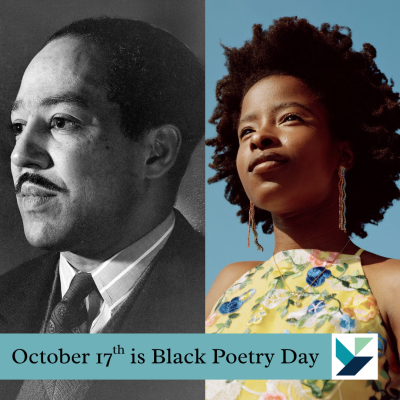
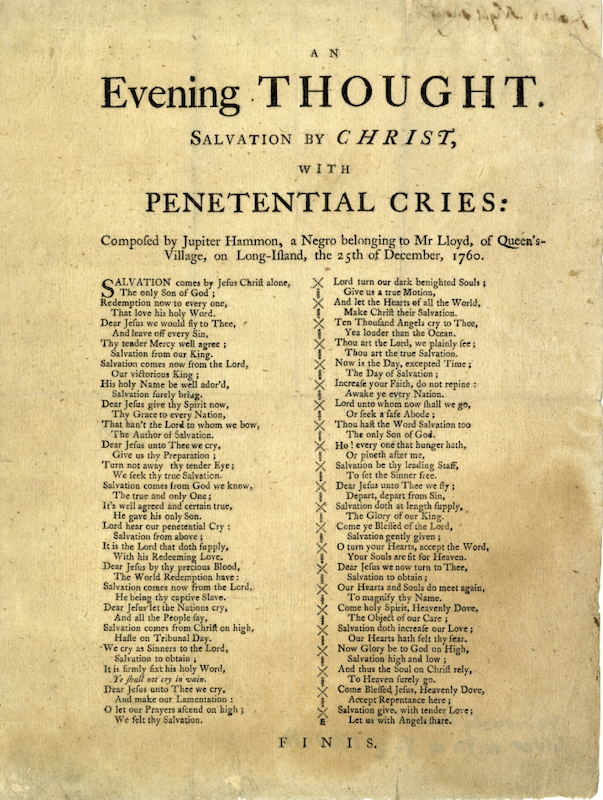
October 17th is Black Poetry Day, and the Crestwood Library has taken this opportunity to highlight some of these influential artists. To give a brief history lesson, the first black poet to be published was Jupiter Hammon (born October 17th, 1711) in 1761, with his poem An Evening Thought. Works by Phillis Wheatley, credited as the first black woman poet, were published shortly thereafter in 1773. Both of these writers grew up in slavery and their writing utilized their Christian faith to persevere in the midst of their struggles and protest the horrid institution. During the Harlem Renaissance, Black artists and writers gained mainstream appeal for the first time in American history. Langston Hughes, Countee Cullen, Claude McKay, Jessie Redmon Fauset, and Zora Neale Hurston are among the names that defined the era’s writings and changed the course of American history with them. Their works focused on exploring their identity as African Americans in the US, rebelling against Jim Crow and segregation, and creating their own style of poetry separate from the romantic poets their white contemporaries were still trying to emulate. In the modern day, poets like Nate Marshall, Jason Reynolds, and Amanda Gorman continue to build upon these themes, bringing attention to contemporary racial inequality and how the youth continue to resist and react to the shifting socio-political landscape.
Below is a brief list of writers that I would recommend reading this Black Poetry Day, but it is far from an exhaustive list. If this post piques your interest, I encourage you to check out resources such as poets.org, poetryfoundation.org, africanamericanpoetry.org, and your local libraries, all of which have a wealth of information regarding these poets and their works.
Langston Hughes (1901-1967): Born in 1901 in Joplin, Missouri, Hughes is the name you’re most likely to think of when the Harlem Renaissance is mentioned. His novels, short stories, plays, and poetry spoke to the common experience of African Americans living throughout the US instead of his sole experience. He emphasized the struggles black people faced while also reveling in the joy their music and culture brought them. Harlem (also known as A Dream Deferred), I, Too, The Negro Speaks of Rivers, Dreams, The Weary Blues, and Mother to Son are some of his most famous works.
Gwendolyn Brooks (1917-2000): My personal favorite of the Harlem Renaissance poets. She is well known for her blending of classical poetic forms with her own inventive and rhythmic style, and her work excels at humanizing her subjects, allowing us to share in their love, loss, and laughter. Her poems We Real Cool (I implore you to read The Golden Shovel by Terrance Hayes right after you finish this one), Boy Breaking Glass, The Bean Eaters, and A Bronzeville Mother Loiters in Mississippi. Meanwhile, A Mississippi Mother Burns Bacon are works I always think of when asked for recommendations.
James Baldwin (1924-1987): Born in Harlem in 1924, James Baldwin is primarily known for novels such as If Beale Street Could Talk, Go Tell It on the Mountain, and Giovanni’s Room than his poems, but I promise that the quality of his writing does not diminish across mediums. As Juan Williams of the Washington Post wrote, “Black people reading Baldwin knew he wrote the truth. White people reading Baldwin sensed his truth about the lives of black people and the sins of a racist nation.” I believe this quote better encapsulates Baldwin’s writing than anything I could ever come up with. It’s powerful, challenging, and emotionally devastating. Everyone should read Baldwin at least once in their lives. I would recommend starting with The giver (for Berdis), Amen, and Staggerlee Wonders.
Audre Lord (1934-1992): Born in Manhattan in 1934, Audre Lord is one of the most famous poets in recent history. She wrote about her experiences as a black woman and a lesbian in an era when few had the guts to be out and proud. She became an important figure in many activist movements thanks to the intersectionality she addressed: to be black and a woman, to be a black woman and gay, and to be a black woman and terminally ill following her diagnosis with breast cancer. Her poems A Litany for Survival, Coal, Power, Hanging Fire, and Who Said It Was Simple are some standouts from her collections.
Nate Marshall (1989-): Born on the South Side of Chicago in 1989, Nate Marshall is already an award-winning author, editor, poet, playwright, and educator. His poetry collection, The Wild Hundreds, perfectly encapsulates the harsh reality and powerlessness black youth face while incorporating the vernacular they would be most familiar with. Read aloud, his poems become performances you won’t forget. They’re emotional gut punches, and if you can’t spare the time to read his whole collections, I would urge you to check out Fame, Food, and Liquor, picking flowers, Finna, and the Harold’s Chicken Shack series.
Amanda Gorman (1998-): Born in Los Angeles in 1998, Amanda Gorman is a newcomer you might recognize from her reading at former President Joe Biden’s inauguration. Her poems, while more geared towards the youth (she wasn’t made National Youth Poet Laureate for nothing!), don’t hesitate to address issues of oppression, marginalization, race, and gender. That being said, some also offer a more hopeful angle, incorporating healing and resilience in the face of adversity. The Hill We Climb, The Miracle of Morning, New Day’s Lyric, The Chorus of Captains, and School’s Out are all good poems to start with.
I hope these author spotlights have fascinated you enough to give them a read today!
Hanora Woodruff is a Part-Time Clerk and patron of Yonkers Crestwood Library since childhood. She recently graduated from Stony Brook University with a degree in Biology and Creative Writing. Her favorite reads at the moment are Sylvia Plath’s poems.