
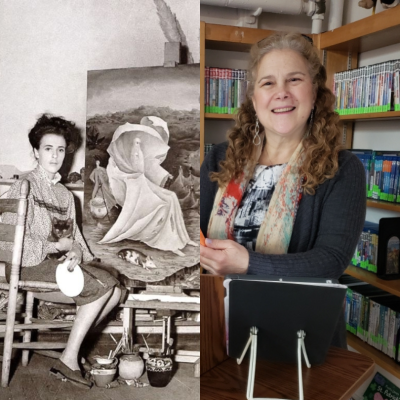
It evokes images of melting clocks, abstract faces, and questions with no definitive answers. The surrealist art movement emerged shortly after World War I as an escape from the extreme turmoil the world had been thrown into. Pieces from this movement largely depict illogical or dreamlike scenes in an effort to create art that expresses the state of the unconscious mind. Notable artists include Salvador Dalí, Max Ernst, Frida Kahlo, and Pablo Picasso.
Recently, a “lost surrealist” has been brought back into the limelight. Leonora Carrington was an English debutante who eloped to Paris in 1937 to be with Max Ernst. After World War II broke out in France and Ernst was arrested, Carrington fled to Spain, where her deteriorating mental state landed her in a psychiatric hospital. There, she was subjected to electroconvulsive therapy and a regimen of strong drugs. When she was finally released, she fled Europe and moved to Mexico, where she spent the remainder of her life until she died in 2011. Today, she is recognized as a key figure in the Mexican feminist movement and one of the country’s most important artists.
The Yonkers Crestwood Library will visit the Katonah Museum of Art to view its exhibit on Leonora Carrington on August 21st at 11:00 a.m. Professor Val Franco hosted a virtual meeting on July 17th to discuss Carrington's work in anticipation of the visit. For those who missed this meeting, Crestwood staff member Hanora Woodruff conducted an interview with Val that would allow library patrons to learn more about Carrington and her work before the visit to the Katonah Museum of Art. The email correspondence went as follows:
Hanora (H): Can you give me a brief explanation as to what type of professor you are? Is any particular field of art your specialty?
Val (V): I teach art history, cinema, English, and literature at the college level, but my focus for Crestwood programming is always about art and different aspects of art. From the history of individual colors to the variety of art movements in the world, the progression of representation in the world of art, and even the contemporary art markets.
Everything is connected in the world of art, so there’s always so much to discuss, explore, and share. It’s really one of my favorite subjects to teach because while the historical art world is established and remarkably broad, the contemporary art world is always evolving. So between past and present - there’s so much to explore and share.
H: How important is the surrealist movement in the broader world of art? Any particularly impactful figures or pieces that went on to influence contemporaries and later generations? What would you say the movement's lasting impact is?
V: The surrealists had a tremendous impact on the way art was created, as well as the way that people approached art because they demanded that it be considered in a different way. I love Dali (as an instigator of Dadaism, and its effects on surrealism), Marcel Duchamp, Man Ray and Meret Oppenheim, among others. They were changing what art was made of, what art represented, and what art spoke about in a very real very dramatic way. We can see the effects of this in the art world today.
H: The exhibit the library plans to visit is on Leonora Carrington, dubbed the "lost surrealist". What do you find particularly interesting/inspiring about her work and her influence on the art world? What feelings do her pieces evoke in you when you look at them?
V: I think it’s very interesting to consider her place in the world, as well as the place of women in the world and in the art world at this time. Her work also brings up how female artists and their work were recognized by galleries, collectors, and museums at the time. Additionally, the difficulties in her life, her mental breakdown and institutionalization, ask us to consider her humanity and the strength and fragility of the human spirit.
Her work explores the subconscious and can often evoke feelings of mystery, curiosity, isolation. It’s always interesting to explore the text position of objects in her work and the way they are represented. I think we’re gonna have a fantastic opportunity to do that with this museum visit.
We hope this post will pique your interest and encourage you to join us on August 21st at 11:00 a.m at the Katonah Museum of Art! You can find directions to the museum by car, train, and other means of transportation here.
Hanora Woodruff is a Part-Time Clerk and patron of Yonkers Crestwood Library since childhood. She recently graduated from Stony Brook University with a degree in Biology and Creative Writing. Her favorite reads at the moment are Sylvia Plath’s poems.