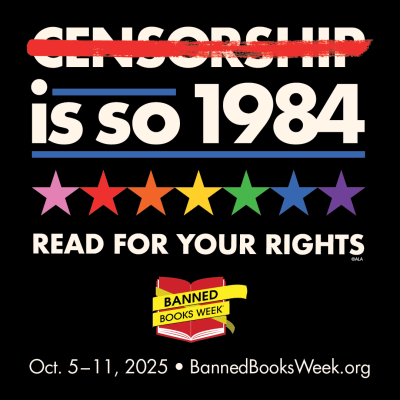
In 1982, Banned Books Week began in response to a major increase in book bans and challenges in libraries, bookstores, and schools across the United States. The goal of Banned Books Week is to emphasize the importance of free, open access to information and to bing together communities in the shared support of the freedom to seek and express ideas.
This year, Banned Books Week will be from October 5-11.
Banned Books Week aims to draw national attention to censorship caused by book bans and challenges across the country. Public libraries and schools face increasing demands for books bans, with 72% of all documented bans coming from organized pressure groups and government entities. In 2024, there were a total of 2,452 unique titles targeted for censorship. While this number is lower than last year, the ALA states that underreporting, legislative restrictions, and censorship by exclusion (libraries aren’t allowed to purchase certain titles or must place them in restricted areas) likely mean there are more book challenges and bans than are accurately documented.
What is a Book Ban?
Book bans often start as book challenges. According to the ALA, a challenge is when an individual or a group of people ask for a book to be removed or restricted based on objections they have about the book. A book ban is when the challenged book is successfully removed from a collection.
Books are challenged and banned for a wide variety of reasons including sexual content, offensive language, LGBTQ content, racism, violence, “anti-family” content, and political viewpoints.
Book challenges are often motivated by a desire to protect others, particularly youth, from content they feel is inappropriate or offensive. However, restricting access to these materials is censorship and violates our First Amendment rights.. The ALA states:
“The right to speak and the right to publish under the First Amendment has been interpreted widely to protect individuals and society from government attempts to suppress ideas and information, and to forbid government censorship of books, magazines, and newspapers as well as art, film, music and materials on the internet.”
Book challenges across the country have increased significantly in recent years. You can check out this interactive map from the ALA to see censorship by the numbers, state-by-state, from 2015 to 2024.
What can you do?
You can celebrate Banned Books Week in a variety of ways.
Exercise your freedom to read: The easiest way to celebrate is to read banned and challenged books. Talk about these reads with your peers or within a book club. Use the hashtag #bannedbooksweek on social media to spread awareness.
Report Challenges: If you hear about a book challenge in your area, contact the Office of Intellectual Freedom (OIF). The OIF estimates that it only learns of 3-18% of book challenges across the country.
Participate in your community: Libraries, bookstores, and literary communities in your area are likely hosting programs and events to celebrate the freedom to read. Show your support and see what’s happening in your neighborhood!
Banned Books
The ALA and the Office of Intellectual Freedom has been collecting data on book bans and challenges since 1990. You can check out this data, as well as lists of the most frequently challenged books, on their website.
Here is the list of the Top 10 Most Challenged Books of 2024:
- All Boys Aren’t Blue by George M. Johnson
- Gender Queer by Maia Kobabe
- (Tied for 3rd) The Bluest Eye by Toni Morrison
- (Tied for 3rd) The Perks of Being a Wallflower by Stephen Chbosky
- Tricks by Ellen Hopkins
- (Tied for 6th/7th) Looking for Alaska by John Green
- (Tied for 6th/7th) Me and Earl and the Dying Girl by Jesse Andrews
- (Tied for 8th/9th) Crank by Ellen Hopkins
- (Tied for 8th/9th) Sold by Patricia McCormick
- Flamer by Mike Curato
You can check out these titles and many other banned books at the Yonkers Public Library. We’ve curated this online list that links to our catalog, but you can always ask a librarian for a recommendation.
Alison Robles, a Yonkers native, received an MS in Information and Library Science from the University at Buffalo. She works at the Crestwood Library and is an avid reader with a passion for YA lit, historical fiction, and fantasy.